
Hydration and Supplementation for Upland Bird Dogs: Why It Matters and How to Do It Right
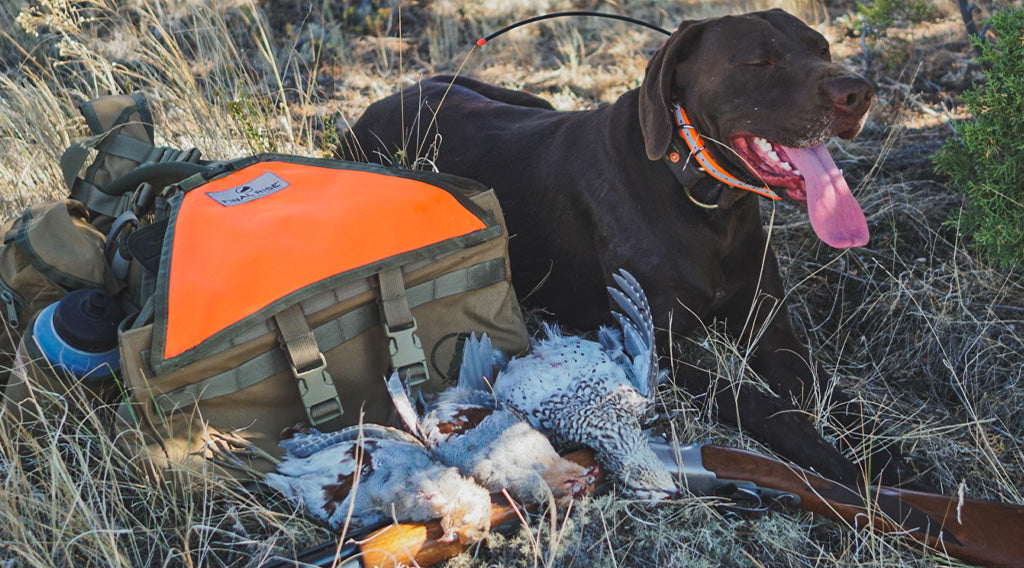
Most hunters can describe the moment their dog falls off. Somewhere in hour five, the range shortens. The head comes up a little less often. The dog is still hunting, but the edge is gone, and it doesn't come back that day.
That fade is usually blamed on conditioning. What's more likely? Often it's hydration.
Why Dogs Dehydrate Faster Than You'd Expect
Your dog cools itself almost entirely by panting. Every breath on a hard run evaporates moisture off the tongue, mouth, and airway, and unlike sweating, it's invisible. There's no wet shirt to tell you how much has been lost. A dog quartering hard through heavy cover is losing water continuously from the first cast to the last.

Two things make this worse in upland hunting specifically.
Dogs are bad at rehydrating voluntarily. A dog running on adrenaline in birdy cover has no interest in a water bowl. Offer plain water at a break and plenty of dogs take three laps and go looking for the next patch of grass. They don't drink to thirst the way we do, and they don't understand to drink ahead of need.
Cold weather hides it. Late-season hunters assume dehydration is a September problem. But - dogs drink less in cold weather while still panting hard through snow and heavy cover, and dry winter air pulls moisture with every breath. Some of the worst hydration days of the year can happen in December.
We can carry all the water we like in something like the Summit XT, but it doesn't matter if they don't want to drink. The practical problem is timing. By the time you can see dehydration: tacky gums, loss of skin elasticity, obvious lethargy, performance has been declining for a while. Hydration is something you stay ahead of, not something you fix.
Water Alone Isn't the Whole Answer
Two things limit plain water in the field.
The first is intake. If your dog won't drink it, its composition doesn't matter. One of my favorite tricks over the years has been to throw some homemade bone broth in my cooler and cut some water with it post-hunt. That's the argument behind flavored, functional hydration like Furvor's hydration bone broth, built to make dogs actually want to drink. Furvor cites a University of Alaska Fairbanks study reporting substantially higher voluntary water consumption and better hydration stability versus water alone. Treat a manufacturer-cited study as one data point, but the principle is sound and every bird dogger knows it. Palatability drives intake, and intake is the whole game.

The second is electrolytes. Dogs lose sodium, potassium, and chloride during sustained work, and those minerals govern nerve signaling and muscle function. Replacing lost fluid without replacing lost electrolytes only solves half the problem. Wilderness Athlete's K9 Athlete Hydrate & Recover is formulated around exactly this — an electrolyte blend of potassium, sodium, and chloride, mixed one scoop into water on active days.

Recovery Is the Multi-Day Problem
A single hunt is a hydration question. A four-day trip to South Dakota is a recovery question.
This is where supplementation moves past electrolytes. Hydrate & Recover pairs its electrolytes with L-glutamine and L-leucine, both amino acids associated with muscle repair and maintenance, plus L-glutathione for antioxidant support. The goal is stacking: helping a dog show up on day three closer to how it looked on day one, rather than accumulating fatigue across the trip.
If you hunt one Saturday at a time, this matters less. If you drive twelve hours to hunt hard for four straight days, it's the difference between a dog that finishes the trip strong and one that's cooked by Wednesday.
Don't Overlook the Gut
Hunting trips are rough on a dog's digestive system. New water sources, travel stress, kennel time, disrupted feeding schedules, and eating whatever's on the ground in a strange field all add up. Trip diarrhea is common enough that most experienced hunters expect it, but a dog with an upset gut isn't absorbing nutrients well, isn't holding water well, and isn't hunting well.
That's the case for gut support like K9 Athlete K9 Pro, which combines a multi-strain probiotic with prebiotic inulin, N-acetyl glucosamine, and digestive enzymes, mixed one scoop daily into food. Gut support is preventive by nature, so it works if you've been running it for weeks, not if you start it the morning you leave.

A Practical Field Protocol
Before the season. Start any new supplement two to four weeks ahead. That gives probiotics time to establish and lets you learn how your dog's stomach handles it at home rather than in a motel room in Pierre.
The night before and morning of. Offer hydration before you need it. A dog that starts the day topped off has a much bigger buffer than one playing catch-up from the first cast.
Every 30 to 45 minutes in the field. Short, frequent water breaks beat long ones. Carry hydration in a bottle or single-serve packs rather than counting on stock tanks and creeks, which may be frozen, fouled, or absent. Use the stop to check feet, eyes, and ears while you're down there.
After the hunt. The window right after work is when recovery support does the most good — fluids, electrolytes, and amino acids while the dog is cooling down and before it eats.
All season, daily. Gut and joint support are daily-habit items. They don't work as a rescue.

An Honest Caveat
Supplements support a well-conditioned, well-fed dog. They don't substitute for off-season conditioning, quality food, or good judgment about when to call a hunt. A dog that isn't fit doesn't need a scoop of anything, it needs miles before the opener.
The Bottom Line
Hydration is the cheapest performance gain available to a bird dog owner, and it's the one most commonly left on the table. You can't out-condition dehydration, and you can't fix it once you can see it.
Stay ahead of it, make it something your dog actually wants to drink, replace what hard work takes out, and give the gut a fighting chance on the road.