
The Paradigm First Aid Field Kit: Why You and Your Hunting Dog Need to Carry One
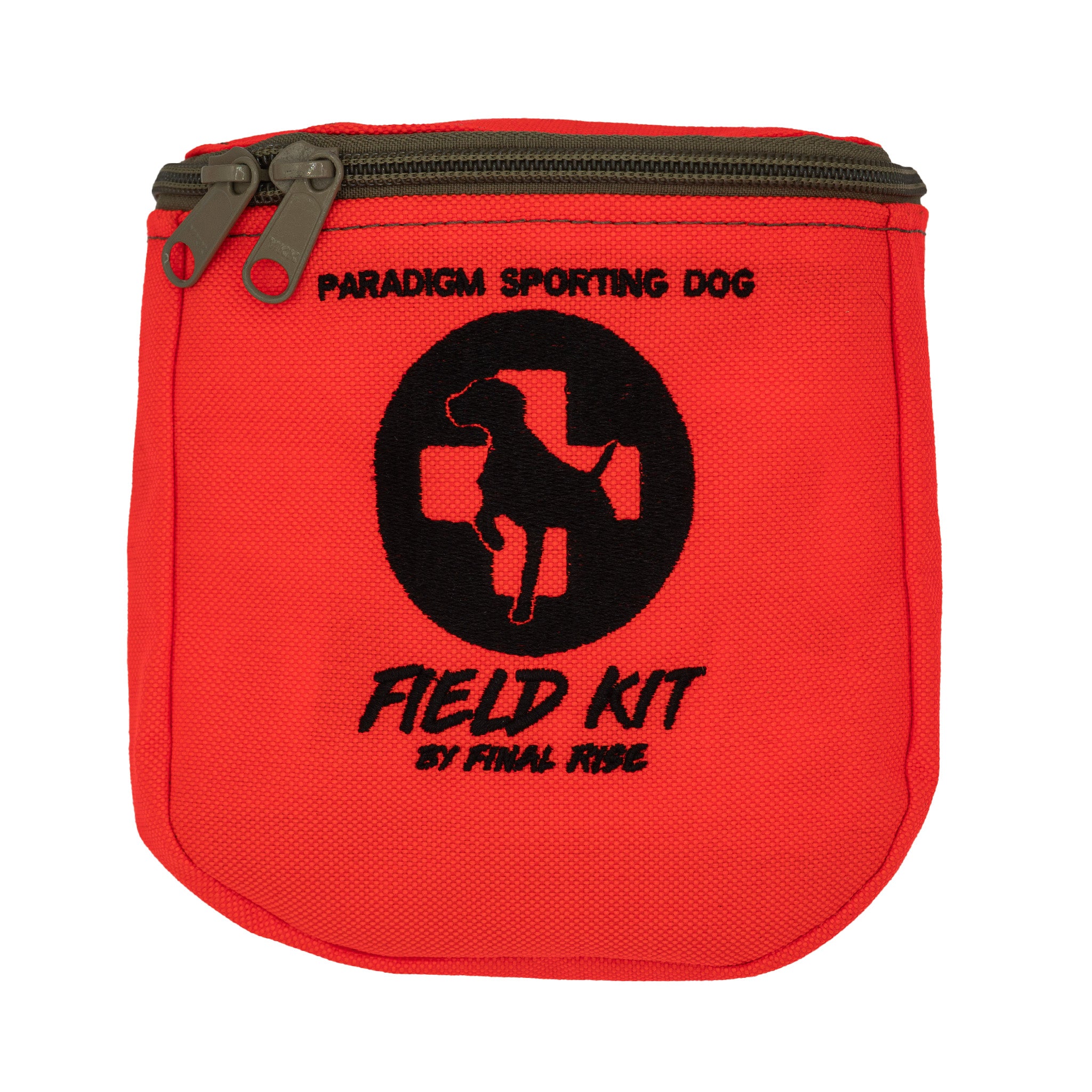
Most bird dog first aid kits are assembled by people who have never had a dog cut open a pad three miles from the truck. Ours wasn't. The First Aid Field Kit was developed in collaboration with Paradigm Sporting Dog and Dr. Clairissa Maples, a dedicated veterinarian and passionate wingshooter and every item in it earned its place.
The kit lives in a 6" x 6" x 3" Cordura pouch that mounts to a Final Rise vest or any MOLLE-compatible gear, so it's on your back when it matters instead of in the truck. It's pre-assembled and ready to grab.
One thing to be clear about up front: this kit is designed to stabilize your dog and buy you time to reach a veterinarian. It is not a substitute for professional care. Everything below is about getting your dog safely off the mountain.
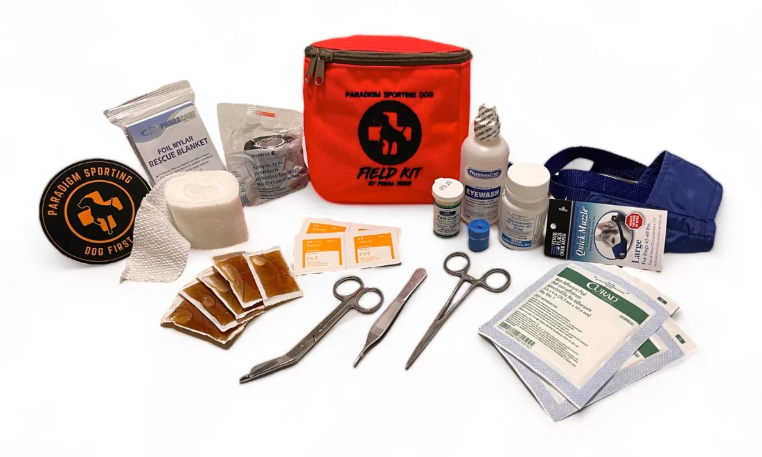
Here's what's inside and when each piece comes out.
Start Here: The Muzzle
What it does: Allows you to safely handle a dog in pain without getting bitten.
When you'll use it: Your dog comes back from a cattail slough with a deep cut on the front leg and won't let you near it. Even the gentlest dog will bite when it hurts — that's not a behavior problem, it's reflex. The muzzle goes on before you do anything else, because a handler with a bitten hand can't help anybody.
Important: Never leave it on unsupervised, and don't use it for extended periods. Dogs can't pant in this style of muzzle, so it comes off as soon as you're done working.

Stopping the Bleeding
Kwik Stop (Styptic) Powder
What it does: Promotes clotting on small, superficial bleeds.
When you'll use it: Your dog tears a toenail on frozen ground, or nicks an ear tip on barbed wire — the kind of injury that bleeds far more dramatically than its severity warrants. A pinch of styptic powder on the spot and the bleeding stops.
Important: If bleeding continues after one or two applications, move to compression with a bandage.

Tourniquet
What it does: Stops severe bleeding on an extremity when nothing else is working.
When you'll use it: This is your worst-case tool — an arterial bleed on a leg, the kind that pulses and doesn't slow with pressure. The tourniquet buys you the time to get to a vet.
Important: Do not remove it once it has been administered and note the time you applied it so you can tell the vet.

Hemostats
What it does: More versatile than any other tool in the kit.
When you'll use it: Three ways. First, clamping a bleeding vessel that isn't responding to pressure or styptic powder. Second, pulling thorns, cactus spines, and seed heads out of a foot or a muzzle - those locking jaws hold what your fingers can't. Third, if your dog gets into porcupines, hemostats are how you pull quills: grip at the base of the quill and pull slowly, re-clamping closer to the skin if a long quill starts to bend.
Bonus use: Clamp the tourniquet with hemostats instead of tying it. It holds just as well and comes off far faster.

Cleaning and Covering a Wound
Alcohol Prep Pads (4)
What they do: Clean your instruments and minor abrasions.
When you'll use them: Before your hemostats go anywhere near a wound, wipe them down. Field tools live in a pouch that's been rained on and bounced through brush all season.
Important: Alcohol stings badly on open tissue. Use these primarily on instruments and minor scrapes, not on deep, raw wounds.

Telfa Pads (2)
What they do: Lint-free, non-adherent pads that go directly over a wound as the first bandage layer, absorbing drainage without sticking.
When you'll use them: Your dog opens a cut on the chest going under a fence. Once it's clean, the Telfa pad goes on first — the layer that touches the wound and doesn't weld itself to it. That matters at the vet's office, when the bandage has to come off without reopening what's healing underneath.

Cast Padding
What it does: The cotton layer that goes over the Telfa pad to cushion and support the injury.
When you'll use it: Wrapping that chest cut, or supporting a leg your dog is favoring on the walk out. Overlap each wrap by 50% and use at least two layers.

Vet Wrap
What it does: Compresses the cast padding and holds the whole bandage together. Self-adhering, so it sticks to itself and not to fur.
When you'll use it: The outer layer over any bandage you build. Overlap 50% each pass.
Important — read this twice: Do not apply it too tightly. Vet wrap can cause vasoconstriction and cut off blood supply to the limb, turning a manageable injury into a serious one. The test: you should be able to easily slide one or two fingers between the padding and your dog's skin. If you can't, take it off and start over.

Bandage Scissors
What they do: Cut bandage material cleanly, with a blunt lower tip designed to slide against skin without cutting it.
When you'll use them: Sizing cast padding and vet wrap while your other hand holds a bandage in place — and, more importantly, removing a bandage you applied too tight without nicking the dog underneath.

Getting Things Out
Thumb Forceps
What they do: Fine-tipped precision grip for the small stuff.
When you'll use them: Your dog comes out of a CRP field working its mouth, and there's a grass awn or a small cactus spine embedded where hemostats are too coarse and your fingers are useless. Forceps get what nothing else can grab.

Saline Eye Wash
What it does: Flushes debris, seeds, and discharge out of the eye.
When you'll use it: Late-season grass seed is the most common eye injury in upland dogs. Your dog is squinting hard and pawing at one eye after a run through heavy cover. Flush it out before that seed scratches the cornea.
Important: Don't touch the bottle tip directly to the eye.

Whole-Dog Emergencies
Benadryl (Diphenhydramine) Capsules
What it does: Treats allergic reactions.
When you'll use it: Your dog gets into a wasp nest, or comes out of the brush with a swelling muzzle and hives. Dr. Maples' guidance is 1 mg per pound of body weight — so a 50-pound dog gets 50 mg. Do the math for your dog before the season starts, not while it's happening.

Honey Packets (5)
What they do: Fast sugar for hypoglycemia (low blood sugar).
When you'll use them: Hour six of a hard day. Your dog starts staggering, goes weak, or develops tremors. Hunting dogs, especially lean, high-drive ones, can burn through their blood sugar and crash. Give one to two packets per episode.
Knowing these signs matters as much as carrying the packets. Staggering, weakness, tremors, or seizures in a dog that's been running hard is a blood sugar problem until proven otherwise.

Emergency Blanket
What it does: Initial triage for hypothermia.
When you'll use it: A December retrieve out of open water, wind picking up, and a wet dog that starts shivering hard on the walk back. The blanket reflects body heat and slows the loss.
Important: This is a place holder, not a solution. A hypothermic dog needs real heat like the truck heater, dry blankets, and a vet if it doesn't turn around quickly.

The Real Value
Look at that list and a pattern shows up. Almost nothing in this kit fixes an injury outright. The styptic powder stops a bleed, the honey packets reverse a crash, but the tourniquet, the bandage layers, the muzzle, the emergency blanket all do the same job: they keep a bad situation from getting worse during the hour it takes you to reach help.
That's what field first aid actually is. Not surgery in a wheat field. Stabilization, control, and time.
The best-case scenario is that you carry this kit for years and never open it past the alcohol pads. But the day your dog needs it, the difference between having it on your vest and having it in the truck is the entire difference.
Shop the First Aid Field Kit — $100
Kit contents developed in collaboration with Paradigm Sporting Dog and Dr. Clairissa Maples, DVM. This kit is intended to stabilize your dog and buy time to reach a veterinarian — it does not replace professional veterinary care. When in doubt, call your vet.