
Fishing in Bear Country: Essential Bear Safety Tips
Fly Fishing in Grizzly Country: Bear Safety Tips Every Angler Should Know
Article By: Razco Holster's Partner - Brenton Moore

There are few things better than standing knee-deep in a cold mountain river with a fly rod in hand. The sound of rushing water, alpine wind through the trees, and the anticipation of a trout rising to a dry fly is hard to beat.
But in many of the best fisheries in North America — from the Yellowstone backcountry to remote Alaska rivers and Montana wilderness streams — you are not always the top predator on the bank.
Fishing in grizzly country comes with real risks.
Fast-moving water masks sound, making it easy to accidentally surprise a bear at close range. Anglers are often focused downstream on a drift, untangling a mess of tippet, or watching a hatch unfold while completely unaware of what may be moving through the brush behind them.
Just like hunting elk, blue grouse, or backcountry mule deer in the Rockies, your chances of encountering a grizzly increase the deeper you go into remote country. Add in the fact that dawn and dusk fishing often overlaps with prime feeding activity for bears, and anglers can quickly find themselves in dangerous situations.
The good news? With the right preparation, awareness, and gear setup, fishing safely in bear country is absolutely manageable.
Why Fly Fishing Can Increase Bear Encounters
Unlike hiking trails where people create constant noise, anglers move quietly and unpredictably through river corridors — exactly where bears travel and feed.
Common factors that increase risk include:
-
Loud water masking your approach
-
Limited visibility along brushy creek bottoms
-
Fish carcasses and food smells
-
Early morning and evening fishing
-
Solitary fishing in remote drainages
River systems naturally funnel wildlife movement, especially in Alaska, Wyoming, Montana, Idaho, and parts of Canada where grizzlies actively feed near spawning fish and waterways.
Essential Bear Safety Tips for Anglers
Make Noise While Moving

A surprised bear is often the most dangerous kind of bear.
When moving between fishing holes, especially through thick vegetation or around blind corners, talk loudly, clap, or make noise periodically so wildlife knows you are approaching.
This is especially important when leaving noisy rivers and entering quiet timber or willow bottoms.
Stay Alert for Bear Sign
Always keep your head up and scan for signs of recent bear activity.
Watch for:
-
Fresh tracks
-
Scat
-
Claw marks
-
Torn logs
-
Day beds
-
Animal carcasses
If you see fresh sign concentrated near the water, it may be smarter to move locations entirely.
Fish With a Partner or Group
Groups are less likely to be approached by bears, and multiple people provide better awareness in remote areas.
Plus, let’s be honest — fishing with your buddies is usually better anyway.
Properly Dispose of Fish Waste
If keeping fish, properly dispose of entrails in deeper moving water away from heavily trafficked banks and campsites.
Never leave fish remains near shorelines, trails, or camp.
Pack out all trash and food waste.
Carry Bear Spray — And Keep It Accessible
Bear spray is widely recommended by wildlife agencies and many experienced outdoorsmen because it is effective at stopping aggressive encounters without requiring pinpoint accuracy under stress.
The important part is accessibility.
Bear spray buried inside a backpack is useless during a fast encounter.
Keep it mounted somewhere you can deploy immediately with either hand.
Firearms for Bear Defense While Fishing

There is endless debate online about the “best” bear gun.
Most people immediately jump to recommending a .44 Magnum, 10mm, or large revolver. While those can absolutely work, caliber matters far less than your ability to draw and shoot accurately under pressure.
Carry something YOU can confidently shoot.
Not what the guy behind the gun counter says you should carry.
A firearm that is uncomfortable, excessively heavy, or difficult for you to control becomes a liability instead of an asset.
Best Ways to Carry Protection While Wading

Your carry setup matters just as much as the tool itself.
Throwing a handgun into the bottom of your pack does nothing for you during a close encounter.
Cheap holsters, poor retention systems, or setups blocked by sling packs and straps can dramatically slow access when seconds matter.
Good Carry Systems Should:
-
Keep your firearm or spray accessible
-
Stay clear of pack straps and buckles
-
Work while wearing waders or a backpack
-
Remain secure during aggressive movement
-
Allow fast one-handed access
High-quality Kydex systems with adjustable retention tend to perform best in wet environments and rugged terrain.
Why Chest Rigs Work Well for Fishing in Bear Country
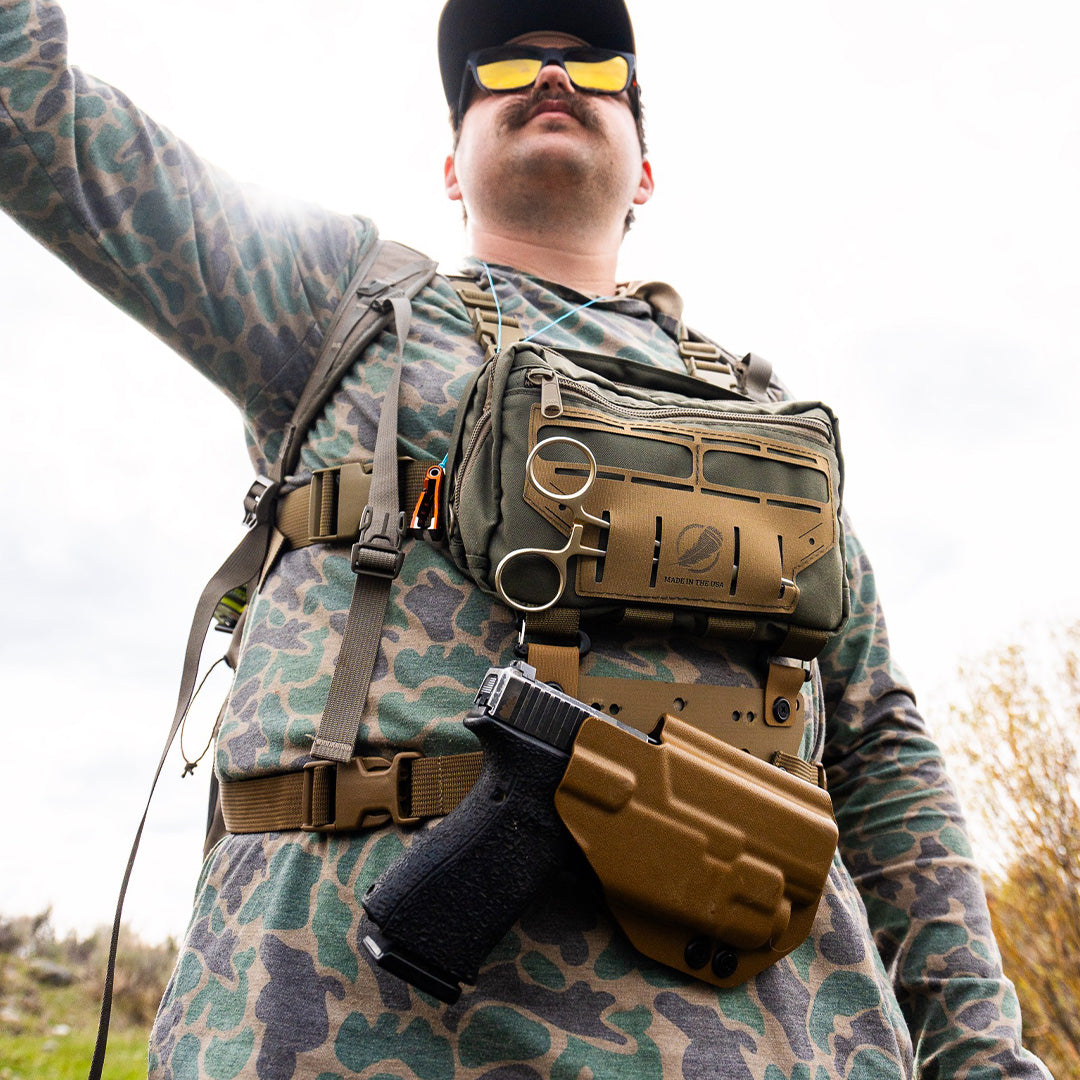
The Final Rise Chest Rig solves many of the problems anglers face when carrying protection in the backcountry.
Its low-profile design allows you to comfortably run:
-
Full-size backpacks
-
Sling packs
-
Waders
-
Camera gear
-
Layering systems
…without interfering with access to essential safety gear.
The rear compartment paired with an internal Velcro holster allows discreet carry of full-size handguns while keeping the draw path clean and unobstructed.
The MOLLE-compatible bottom section also provides an excellent mounting location for:
-
Bear spray
-
Kydex holsters
-
Utility pouches
-
Quick-access accessories
When things happen fast, simplicity matters.
A clean, repeatable draw can save your life.
Bear Defense Carry Tips for Anglers
Choose a Firearm You Can Actually Shoot Well
Fast, accurate hits matter more than raw caliber.
Train with what you carry.
Use a Quality Holster
Avoid floppy nylon holsters or loose retention systems.
A quality Kydex holster provides:
-
Better retention
-
Faster access
-
Weather resistance
-
More consistent draws
Keep Your Draw Path Clear
Avoid tangled straps, buckles, and chest clutter that can interfere with deployment.
Practice drawing while wearing your actual fishing setup.
Use Proper Ammunition
For bear defense, many experienced outdoorsmen prefer hard-cast loads designed for deep penetration.
Popular options include:
-
Buffalo Bore
-
Underwood
-
G9 Woodsman
Test reliability and function with your specific firearm before relying on it in the field.
Train Regularly
Owning gear does not equal preparedness.
Practice:
-
Drawing from your fishing setup
-
One-handed deployment
-
Shooting under stress
-
Bear spray deployment drills
Expired bear spray cans and inert training cans are excellent tools for realistic practice.
Yes — bear spray expires.
What To Do If You Encounter a Bear While Fishing
If you encounter a bear:
-
Stay calm
-
Do not run
-
Speak calmly and back away slowly
-
Give the bear space
-
Prepare your spray if needed
-
Avoid direct eye contact
-
If charged, deploy spray when the bear closes distance
Every encounter is different, and understanding bear behavior is critical.
Final Thoughts on Fishing Safely in Grizzly Country

Bears were here long before we arrived with fly rods, and they deserve respect.
Fishing in grizzly country is one of the greatest experiences in North America, but it requires awareness, preparation, and the right equipment.
Bear spray and firearms are not mutually exclusive. Many experienced anglers carry both.
Stay alert. Train with your gear. Respect wildlife. And make sure the only thing you bring home from the river is a good story and maybe a few photos of wild trout.