



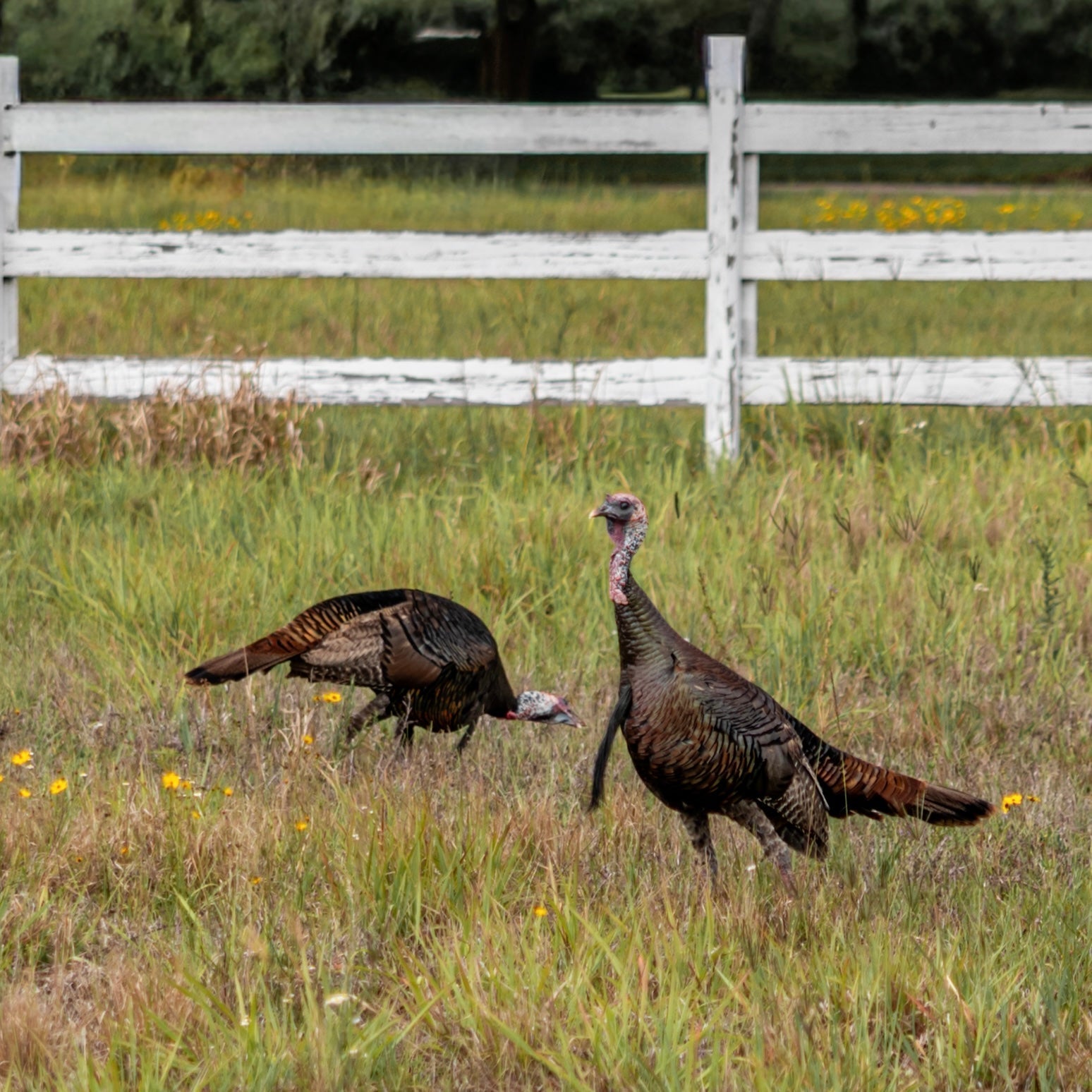
A Tale of Two Turkeys: Hunting Merriam’s and Osceolas Across the Country

A Tale of Two Turkeys: Hunting Merriam’s and Osceolas Across the Country
By: Dan Towsley
Across the turkey woods, two birds stand apart for the vastly different hunts they demand: the high-country Merriam’s of the West or the swamp-running Osceola of Florida. One will have you gasping for air on a ridge during dawn patrol, the other will leave you sweating through a shirt before the sun even breaks the horizon. Different terrain, different tactics, but still the same obsession.
That anticipation carried right into the night before opening day. That same frantic, excited energy running through gear, making sure everything’s packed and ready. Decoys, Final Rise Chest Rig, calls, strikers, face mask… got it all. Then comes that lingering thought, what am I forgetting?
But what goes in your pack starts to change depending on where you are. Out West, you start adding things like a water filter, gaiters, maybe even a lightweight mobile blind. Because if you’re hunting public land, there’s a good chance you’ll be covering miles just to find birds, let alone get a shot at one. Having hunted turkeys out west for over a decade now I have learned the ins and outs of a merriam's turkey. From habitat & daily tendencies, to calling sequences & tactics.
For the opener this year, I had been keeping tabs on a tom and his two hens for a couple weeks. Watching their patterns, learning where they liked to move midday, and even narrowing down their exact roost tree.
Opening morning, I slipped in and set up with just a lone jake decoy. The hens started yelping early, with the tom roosted about a hundred yards off in a separate tree. I knew if I could pull those hens my way, that tom wouldn’t be far behind.
I stayed on the slate, mixing in yelps and purrs to keep the hens interested. Before long, I caught movement, looked up and saw that tom coming in, full strut, spitting and drumming the whole way. The hens worked right into about three yards while I stayed tucked into a couple small lodgepole pines.
As soon as the tom caught sight of that decoy, he came in on a string. I let him work it over for a few minutes long enough to grab some photos and videos. When he finally stepped clear and gave me a clean shot, that was it. Another beautiful Merriam’s on the ground. These birds keep me on my feet learning year after year. I won’t say chasing any sub species of turkeys are easy, but having hunted Merriams now for many years I have learned and picked up their subtleties.
Chasing Osceolas, on the other hand, was a completely different pace. I got my first crack at one on the last day of the season down in Florida, hunting with Jon Lingo, a local who’s been chasing birds in that area for over thirty years. Even with his experience, we both knew the odds weren’t exactly in our favor. With limited time left in the season, it came down to one simple mindset: make it happen, or go home empty-handed.
That morning, Jon & I slipped in and set up beneath a big live oak. We set up a hen and jake decoy, and then listened as the woods came alive. Cardinals, whip-poor-wills, and owls cut through the dark, everything easing into daylight. It didn’t take long to realize this place had history. Birds had been killed here year after year, even a big tom earlier this season by Jon.
But honestly, that didn’t weigh on me much. Just being there, sharing the woods with a subspecies I’d never hunted before - was enough to get the blood going.
About thirty minutes in, we caught our first gobble. Faint. Distant. One of those where you look at each other like, did you actually hear that? Roughly five hundred yards out. A couple minutes later, after I hit the pot call, he answered again, this time no question about it. He was there, and he was ready to talk.
My rule of thumb is to give a bird time, usually about twenty minutes between calling, especially when you’re dealing with spooky, pressured toms. So we sat there, listening, waiting to see if he was working his way in between gobbles.
Right on cue, he fired off again and this time he sounded closer. I eased into a few soft yelps on the mouth call, then added some purrs on the slate. He didn’t hesitate. He hammered back with a string of gobbles.
We both looked at each other and couldn’t help but smile. In that moment, it felt like everything was coming together like we had that bird right where we wanted him… just like we’d played it out in our heads.
Or so we thought.
Whether you’re chasing Merriam’s out West or Osceolas in Florida, those walnut-sized brains have a way of humbling even the most seasoned hunters. This tom did exactly that. He hung up just out of reach, hanging out on the neighboring five-thousand-acre ranch where we couldn’t follow.
With only one day to hunt, early-season conditions, and hens already having groups of poults, that was all she wrote. I had to chalk it up as a loss. But honestly, it didn’t feel like one. Getting the chance to experience an Osceola hunt in Florida; the sounds, pace, the challenge was worth it all on its own, just knowing I get to go back down next year with my unchecked tag.
The truth is, these birds may share a name, but they live entirely different lives. From the cottonwood filled river bottoms and mountain draws out West to the palmetto flats and oak hammocks of Florida, each subspecies demands something different from the hunter. And after chasing both, I started to realize the question isn’t which one is harder; it’s how they’re hard in their own way.