
Ruffed Grouse Marabou Streamer: A Fly-Tying Guide for Brook Trout
A good friend of mine has a small waterfowl lifestyle brand called Full Circle Waterfowl. The question he poses on social media and his website is often “What makes your hunt come full circle?”
I often think back to this question and reflect on it in my own outdoor pursuits.
For me, it’s the connection. The connection to the people I hunt with and the dogs. The connection to the wild public places where we have the right to hunt. The connection to the food we harvest from the creatures we pursue. And finally, the connection to the birds themselves. From their habits to their plumage, the details are endless.

For me, as an avid flyfisherman, these feathers bring more than just a momentary pause to enjoy the beauty of God’s creation in my hand after a successful hunt or tail feathers displayed on the wall of my workshop. From flank feathers and CDC from ducks to my personal favorite, marabou from practically any game bird, these incredible birds that we pursue can take on another life as we pursue fish in the months between bird seasons.
Marabou and it’s Origins
Marabou is a very common fly-tying material sourced from domestic turkeys. It’s the soft, down feathers found around the back legs near the vent. Historically, feathers from the Marabou Stork from Sub-Saharan Africa were used, but this practice was outlawed when various game laws were passed.

If you are creative, feathers on the Ruffed Grouse can be used for a myriad of flies. For me, the Marabou makes the perfect tails on the little jig-style streamers I have come to favor when chasing native brook trout in their native streams of the Pennsylvania highlands. Most marabou you buy from the fly shop is dyed in various colors. I enjoy the two-toned feathers from the butt of the ruffed grouse. The white tips and grey in the back make for a striking tail when combined with some very basic fly tying skills.
We’ll walk you through how I tie them and how I like to fish them. I keep a spare zip-top bag tucked in the game pouch of my Final Rise Summit XT for exactly this reason, so grouse marabou from a good hunt can be used later.
What You’ll Need: Tools and Materials
-
Vice
-
Whip Finish Tool
-
Bobbin
-
Scissors
-
Hackle Pliers
-
Ruffed Grouse/Game Bird Marabou
-
Any color of ice dubbing (I like purple for Brook Trout)
-
Lead-Free Wire .015
-
Black Saddle Hackle
-
Jig hook size 8 or 10 with appropriately sized tungsten bead
-
Black or really any color thread. Personally, I prefer Orange
-
UV Resin or Head Cement
Step One: Weight the Hook and Tie In the Marabou Tail
Start by setting your hook in the vice securely with the tungsten bead slipped on. Wrap the wire from behind the bead to about halfway to the bend of the hook. I like to use these flies in deeper pools, so I appreciate having some extra weight on them.

Then start your thread wrap, secure the bead, and work your way back to the hook. Grab a marabou feather and strip the fuzzy fibers off until you have a clean feather with half of the shaft exposed. Tie that into the top of the hook.
Step Two: Add Ice Dub and Hackle
Take some Ice Dub and roll it onto a two-inch length of thread. Less is more here, too much and it will be more than the fly can handle, and it will lose a lot of volume as you fish it. Tie that in from where the tail starts all the way to the bead. Next, grab your saddle hackle and find a piece that tickles your fancy; some of these will be too long or too stubby. Try to find one right in the middle.

Tie the feather in, wrap your thread to the back of the fly and use hackle pliers to wrap the hackle back to the tail. Finally, with your thread, reinforce the hackle by weaving it around the barbs so as not to press too many of them down, and make your way back to the bead of the fly.
Finishing Touches: Whip Finish and Seal the Head
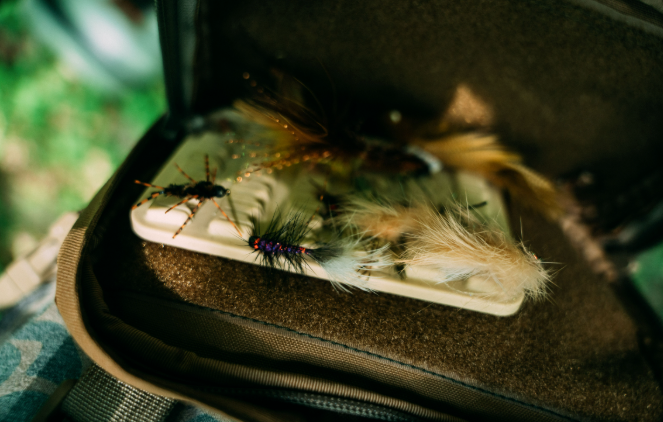
Whip finish around the head and add some head cement or UV resin and hit it with your UV flashlight. Let dry and add to your fly box.
How to Fish It: Presentation Tips for Brook Trout
From dead drifting, stripping, or tight lining, this fly can be fished almost any way. I tend to sneak up to pools and runs and simply roll cast it into likely locations with limited slack. Slowing, snapping my rod back downstream in small, sharp movements. With its lead wrap and tungsten head, this fly can drop deep into plunge pools but is still light enough to cast far up into a riffle run section of the stream and strip towards you. I have found it effective in all circumstances, and it is a go-to fly for me.

Catching native Brook Trout from native Ruffed Grouse that my dogs and I have successfully pursued in the fall brings the hunt full circle for me. It is a way for me to utilize more of the birds we hunt and to keep the memories of my favorite hunts at the forefront of my mind. We hope that you’ll attempt to do the same!
By Kevin Erdvig